Detect. Decide.
Manoeuvre.
Two units, one system. P1S Buddy sees the threat and decides. P1S PELTAST-X moves the satellite out of the way. No person in the loop.
The self-defending satellite.
No ground loop. The AI never drives the thruster directly. It asks for a manoeuvre, and a validated propulsion controller runs it inside a safe envelope. The same interface works with our thruster or a third-party thruster the satellite already carries.
Integrated kit
P1S Buddy and P1S PELTAST-X together. One kit per satellite, one integration.
P1S Buddy
The AI unit on its own. Works with any thruster the satellite already carries.
P1S PELTAST-X
The water thruster on its own. Gentle moves or a fast burst.
P1S Buddy
TRL 4 · TRL 5–6 by end of 2026
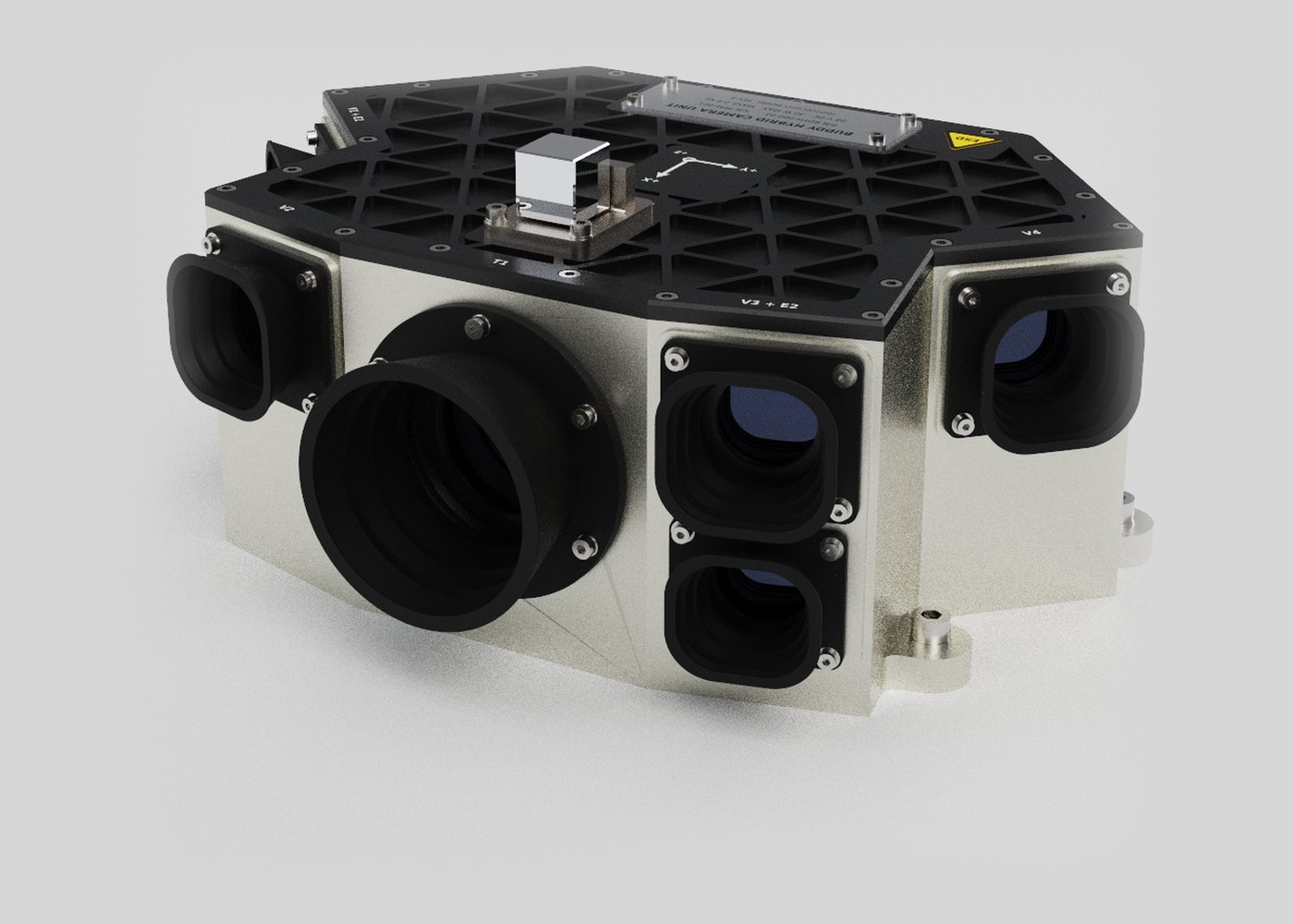
The onboard AI unit that sees what is around the satellite and decides what to do. When a conjunction warning arrives or an object comes close, Buddy plans the avoidance manoeuvre onboard. No ground loop, no waiting on a flight-dynamics team.
New models go up over the air, so Buddy gets better after launch. It flies in December 2027.
Autonomous collision avoidance
Takes a conjunction warning, then plans, checks and runs the avoidance manoeuvre onboard. No person in the loop. Every command passes a safety shield before it reaches the thruster.
Sees what is around it
Visible, event-based and thermal cameras track nearby objects in sunlight and in eclipse: range, pose and velocity. The AI model is designed to run under 5 W.
Spots threats, sends a short alert
An orbital-mechanics filter flags an object that manoeuvres to match your orbit. It sends a small alert: class, range, vector, confidence. Kilobytes, not video.
P1S PELTAST-X
TRL 3 · TRL 4–5 by end of 2026
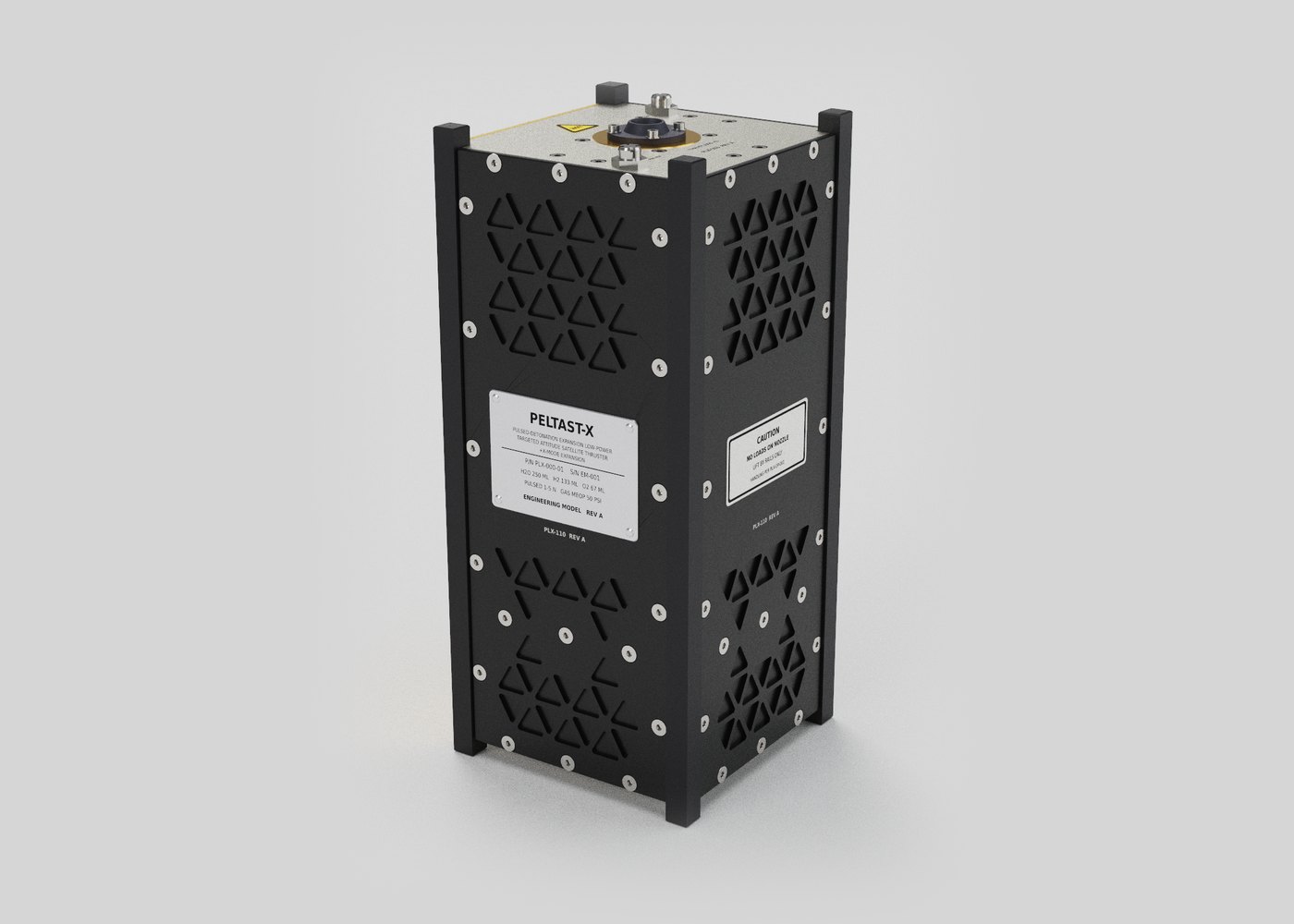
A water-fuelled hybrid thruster. Precise cold-gas modes do routine work. A pulsed combustion mode gives short, strong pulses for fast avoidance. Moderate thrust: ~8–40 mN cold gas · 1–5 N pulsed.
It covers station keeping, collision avoidance, orbit changes and controlled deorbit, on a propellant that is safe to launch. It flies in mid-2028.
Water to H₂ and O₂
The thruster launches with 250 mL of plain water, unpressurized. In orbit it splits the water into hydrogen and oxygen. No toxic propellant.
Cold gas plus pulsed combustion
H₂, O₂ and mixed cold gas handle fine control and routine work. A pulsed combustion mode gives short, strong pulses when the satellite must move. ~8–40 mN cold gas · 1–5 N pulsed.
Sized for small satellites
The whole unit fits a 2U bay: 1.8 kg dry, 2.0 kg with water. It works with satellites of any mass.
| Propellant | Launch classification |
|---|---|
| Hydrazine | HAZMAT Class 6.1, toxic |
| Xenon | High-pressure vessel |
| Iodine | Corrosive, special manifesting |
| Water | Non-hazardous, standard cargo |
Two units.
One system.
Each unit works on its own or as one subsystem. Both run on 28 V and talk to the host computer over CAN or RS-422.
| P1S Buddy | P1S PELTAST-X | |
|---|---|---|
| Role | Sees, tracks and reports objects around the satellite | Avoidance, station keeping and deorbit |
| Size | 232 × 191 × 107 mm | 2U, 100 × 100 × 227 mm |
| Mass | 2.4 kg | 1.8 kg dry, 2.0 kg with water |
| Power | 25 W orbit average, 31 W peak | 20 W while making gas, 3 W standby |
| Supply | 28 V DC | 28 V DC |
| Data | Gigabit Ethernet, CSP over CAN, RS-422, PPS | CSP over CAN, RS-422 |
| Modes | Survey, encounter recording, eclipse watch | Cold gas (H₂, O₂ or mixed), pulsed combustion |
| Performance | 10 cm object in sunlight at 83 km; 1 m object in eclipse at 24 km; 88% of 10 cm crossings seen | ~8–40 mN cold gas, 1–5 N pulsed; 470 N·s total impulse; 24 m/s for a 20 kg satellite |
| Response | Detection report every 0.1 s | Valves open in 2–5 ms |
| Onboard store | 1 TB of encounter recordings | 250 mL of water, unpressurized at launch |
Modelled and design values. Bench tests confirm them through 2026–2027.
Download brochure (PDF)Up to TRL 6 by end of 2026.
Flight proven by 2028.
| Product | Today | End of 2026 | In orbit | Flight proven |
|---|---|---|---|---|
| P1S Buddy · AI unit | TRL 4 | TRL 5–6 | December 2027 | TRL 9 · 2027 |
| P1S PELTAST-X · Propulsion | TRL 3 | TRL 4–5 | Mid-2028 | TRL 9 · 2028 |
| Buddy + PELTAST-X · Integrated system | TRL 3 | TRL 4–5 | Mid-2028 | TRL 9 · 2028 |
Every flying unit comes with a yearly AI licence. Software updates are sent up from the ground.
Want the full picture?
Add P1S Buddy and P1S PELTAST-X to your next mission. Sales and documentation: dennis@playeronespace.com